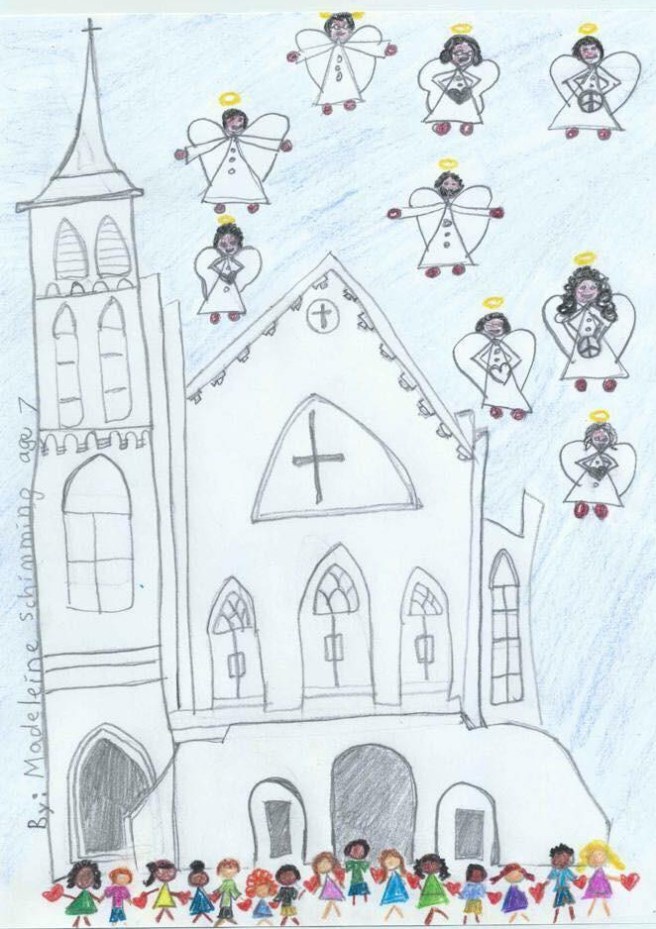
Like most teenagers today, Dylan breathed in the world through carefully selected Google search results, slanted news blogs, violent video games, and ignorant Twitter rants. Knowing nothing but a web of anger, that 19-year-old boy drove to Charleston with virtual hate in his heart. And real bullets in his gun.
Drawing by Madeleine Schimming, Age 7, Charleston, SC
—
This piece was part of a creative writing challenge to write a complete story in 50 words or less.
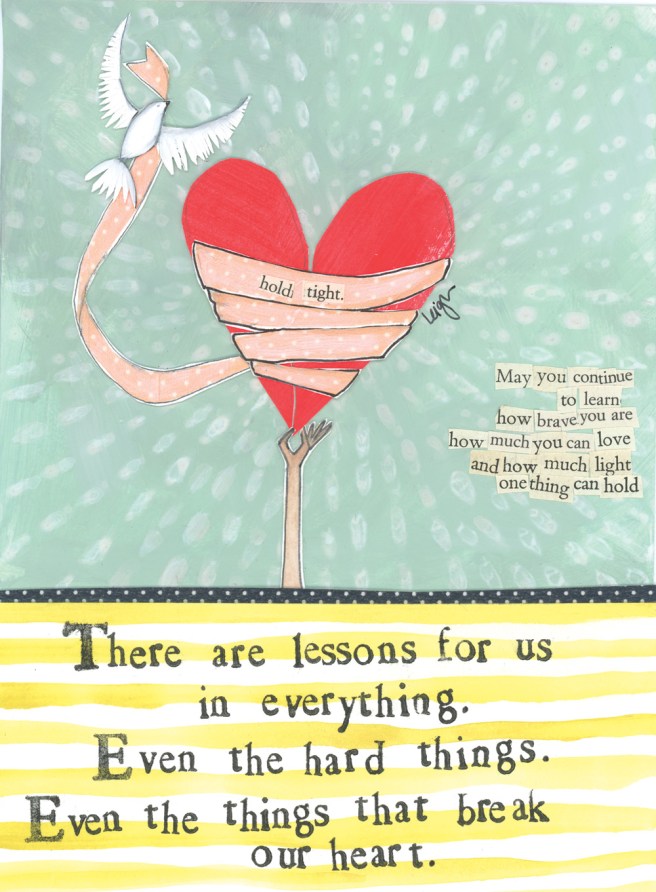
When I lost her–my mother, my gypsy, my patron saint of love and kindness–the echoes first began.
“It gets better. Just wait. It’ll get better.”
I hated every person who offered me those words. For their guilty eyes and soft voices. For their pity. For filling my head with false promises of tranquility, impossible visions of peace.
How could it possibly get better?
Every day that passes I’m 24 hours more removed from the last time she held me in her arms. The last time she stroked my hair. The last time she spoke three infinitely more soothing words.
“I love you.”
Every day that passes my vision of her fades just slightly more. Her image fuzzes around the edges. Pixelates. Unnoticed from one day to the next. But combined, she’s becoming a blur.
I claw through my memories trying to find one of her laugh. One of her hum. One of her silly smiles. I feel victorious when a forgotten detail surfaces—in photograph or video or voicemail or dream.
But I know I have no ownership over those stolen moments. I know I’ll lose those details too.
Give it another day.
With each changing season, the things she’s given me age. Shirts, shoes, sunglasses, jewelry, watches, purses and more. I won’t leave the house without one of those priceless gifts. At least one thing. Maybe the Tiffany earrings she and my sister went in on together for my college graduation. Or the Tom’s sunglasses she gave me our last Christmas together.
Our last Christmas.
But those objects, those items, those physical incarnations of her love and generosity—they are not immune to the mighty arms of time either. Jewelry is lost. Shoes wear down. Sunglasses break. Every day I have less of her to weave into my wardrobe. To wear her love like a blanket on my skin.
How could it possibly get better?
My dreams—the ones where she’s still alive—they’re treasures. I experience her just as she was. I wake up surrounded in the warmth of her. And long to drift back to the place where she lives in my subconscious.
But every day that passes, I have them less and less.
It can’t ever get better.
Now as I wind through my second full year without her, I know the words I’ve hated for so long are true.
It’s getting better.
I wouldn’t call it peace, but time has given me something I didn’t know it could. As I try to balance holding on and letting go and moving forward while desperately clinging to the past, as I fight to forget nothing and even as I continuously fail, time still offers a comfort.
A new echo caressing my ears. Of “This is okay.” Of “This is what is.”
Of acceptance.
She’s not here. I’ll never not miss her. I’ll never not wish I had more time. I’ll never not want even one more day by her side. I’ll never stop trying to remember more pieces of her. I’ll never stop mourning them as they fade too far away into the darkness of my fragile, fallible, feeble human mind.
But still—even still—it’s better.
And I’m grateful to everyone who told me so.
And even more grateful that they were right.
__
Image Source: CurlyGirlDesign.com, maker of the best greeting cards in the whole beautiful world.
Back in the beginning—before forever, before goodbye, before everything—we sparkled. Our mouths ached from our gaping smiles. Our palms were damp from hours spent with fingers interlocked. Our bellies were tight from endless laughter.
We were bright. Shiny. New. We were diamonds glittering across the sea.
Back in the beginning, you strung up paper hearts for Valentine’s Day. Hand-cut from newspaper, looped together in twine. A clumsy garland of headlines and obituaries and classified ads selling away the things that were once thought valuable.
I saw those black and white hearts hanging lopsided around the living room, and I laughed.
And that’s when you dug it out from your pocket.
Such a simple question: will you be with me always?
Such an easy answer: I will. I am. I do.
But like buying a diamond ring on credit, I should have known then that nothing is ever that easy.
You picked it out from the jewelry department at Kohl’s. It was sized too big for my knobby finger, but that didn’t stop me from gawking at it, left arm outstretched, fingers arched proudly to the sky.
I wore that precious five-stone set for six years, never understanding why it felt so heavy. Never figuring out how something so small carried so much weight. Or why my palms—no longer found snuggled next to yours—sweated at the thought of just one more year with this ring, this gift, this promise chaining me to you.
In the end—after stillness, after apathy, after everything—that diamond was the last of our sparkle. Our lips formed only straight lines. Our laughter choked by so much left unsaid.
In the end, I found the clarity that solitaire had all along—when I realized there’s more to happiness than carats and cuts.
And I listed the ring in a classified ad of its own.
MUCH MORE BEAUTIFUL IN PERSON. PICTURES DON’T DO IT JUSTICE.
Now I wait for some new young lover to buy it and surprise his girlfriend with the proposition of a lifetime. And I’ll whisper “I’m sorry” as I pass it off, tucked securely in the same grey suede box you hid in the pocket of your jeans so many years ago.
I’m sorry I didn’t know me better.
I’m sorry I didn’t know me sooner.
But I’m not sorry for following my heart.
—
This piece was written as part of a creative fiction challenge in which I found a classified ad and developed the story behind the ad.
I’m not black. And I’ve never been the victim of a hate crime. But I do know something about this kind of hate. The kind born from ignorance. From unintelligence. The kind that never learned how to evolve. Or how to think for itself. The kind that only regurgitated the hate it was fed its whole life without ever questioning its validity. Without ever assessing its merit, its truths.
When that 21-year-old boy’s father gave him a gun for his birthday, did he think about what else he’d given him? Had he given him the ability to know right for wrong? Had he given him his own prejudices?
Did he tell him the purest truths: That all human beings are beautiful? That all life is precious? That all places of worship are sacred?
What else was given to that boy before someone pushed a cool metal barrel into his sweaty palms?
We are not born with hate. But we breed it. We create it. We allow for it.
And now we all suffer the consequences of this kind of hate.
But I will not pretend I don’t have a role in this crisis; we are all a part of the world we create.
So let’s give our children the gifts of love and knowledge, not bullets and guns. Let’s arm them with the ability to question norms, not destroy what is different. Let’s give them the chance to be better than the generations before them. And pray they never know the hollow and helpless feeling that comes from witnessing this kind of hate.
“If I am ever told that I have one day to live, I will head straight for the hallowed halls of Winter Park High School, where a day has been known to last a thousand years.” (pg. 21)
“That’s always seemed so ridiculous to me, that people want to be around someone because they’re pretty. It’s like picking your breakfast cereal based on color instead of taste.” (pg. 36)
“It’s so hard to leave—until you leave. And then it is the easiest god-damned thing in the world.” (pg. 192)
“Before he was this minor figure in the drama of my life, he was—you know, the central figure in the drama of his own life.” (pg. 267)
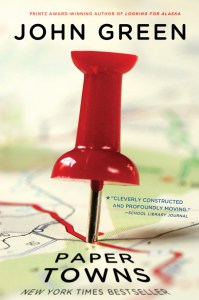
Synopsis: Margo Roth Spiegelman and Quentin Johnson (Q) grow up as neighbors. Even though a traumatic childhood event ties them together, they’ve never been more than mere acquaintances. That is until their senior year in high school when Margo shows up in Q’s bedroom window one night and convinces him to join her on a spree of vengeance-fueled pranks. After spending the night wreaking havoc on their frenemies together, Margot doesn’t show up for school the next day. Instead, she vanishes—leaving clues as to where she has gone in her wake. Clues that are just for Q.
Opinion:
I loved The Fault in Our Stars. I loved it so much, I even read Looking for Alaska (which is a big deal because I prefer not to re-read authors). Paper Towns was selected by my book club for our February read, and I was excited to have an excuse to pick up Green again.
That being said, this book reminded me exactly why I don’t re-read authors.
Having read all three of these Green books, it’s impossible to miss the similarities. Green builds the same relationship between the central male and female characters. One is unfathomably amazing and sophisticated and desirable and unattainable. And the other is hopelessly in love with him or her.
Such is the set up for Fault and Alaska and alas, for Paper Towns–with Margot as the endless object of Q’s completely one-sided affection.
What Green does so well, however, is capture the essence of uninhibited teenage infatuation, youthful exuberance, and even adorable immaturity. His portrayals of teenagers are so accurate they’re both amusing and nostalgic.
Part I of this book—the all-night prank extravaganza—sets Paper Towns up for success with a quick pace and plenty of action. Likewise, Part III—the graduation-day road trip—is engaging, dynamic, and full of humor. It’s Part II that felt labored, repetitive, and painful, like taking the longest route possible to get to a destination.
Despite that, this book was enjoyable to read overall. And even with an accurately portrayed juvenile ensemble, it managed to touch on some complex and critical adult themes—identity, vanity, what makes life worth living, and how much do we truly know about ourselves and others. From screennames to dialogue to teenage eccentricities, Green once again captures the essence of humans at their most vulnerable age—when we struggle to know nothing and everything all at the same time.
Overall: 3 out of 5
Who Should Read This Book: If you’re an adult who loved other John Green books, I wouldn’t read this one. If you’re someone who hasn’t read other John Green books, I would read The Fault in Our Stars or Looking for Alaska, but again, not this one. But if you’re a detached, misfit, or misunderstood teenager looking for a relatable read with some important heavier themes, Paper Towns is the Green book for you.
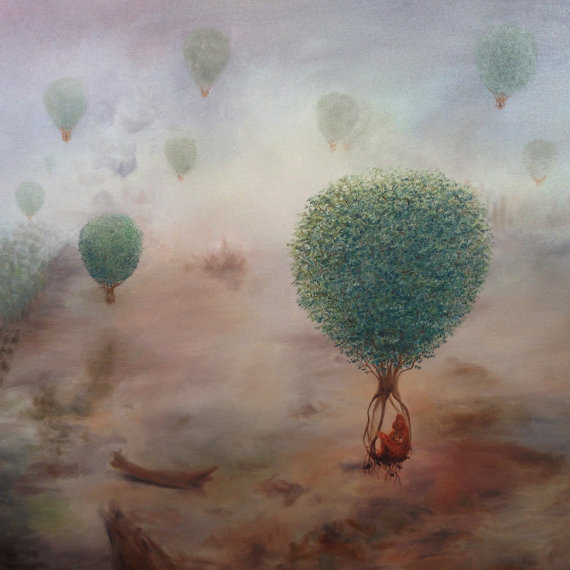
My childhood was rooted in the metro-suburbiapocalypse of Marietta, Georgia. I grew up next to the roots of the live Christmas trees we planted each year. (And I proudly named each one: Candy Cane, Cup Cake, Ginger Bread.) My roots stretched out beneath the small patch of strawberries that grew on the sunny side of the house…beside the earthworms I saved from drying out on the driveway after every heavy rain. My roots are in the grassy slope in the front yard where we put the Slip ‘N Slide each summer. And running under the single tree in the front yard where Dad insisted we put every last strand of 300-count ultra-bright Christmas lights one embarrassing holiday season.
I was planted there. It’s where I bloomed shyly, blossomed hesitantly. And before I knew how to stay put, I was carried away. Like pollen stolen by the honey bees.
My adolescent roots are just down the road from that little blue ranch house. In a bigger brick home with a smaller yard. Dad and I dug up all the seedling trees we’d planted at Milford Creek Lane and transplanted them to new house on Breconridge Drive. They were Fraser firs. Only a handful survived the move. But the few that did grow tall and proud there still today.
My roots are in the soft grass I ran over in the yard as I learned how to back the Mustang out of our crooked driveway for the first, second, and fifteenth times. And beneath the daylilies surrounding the front porch, which served as a backdrop for prom photos and high school graduation portraits. My roots are anchored to the honeysuckles that bloomed along our rustic fence in the springtime. And the jonquils planted around our sweet dog Sunny’s otherwise-unmarked grave in the backyard.
Some days, those roots still feel like home.
Then there was college, the place where you barely stand still long enough to let roots grow. From dorm to apartment to college house, my roots kept me coming back to family and familiarity on holiday weekends and breaks between semesters. To make sure life still existed the way I remembered, even as I was beginning to change.
After college, I left for Charleston. It was a temporary move at the time, but now I’ve been here six and a half years. My roots started tugging me into place in this coastal town—beneath the coarse sand, beneath the pluff mud, beneath the marsh grass—as soon as I arrived. Urging me to stay. Telling me this is the place. This is the place where I can flourish.
Now, having closed on my first home, I’m ready to buy my own Christmas trees for the yard…and give them good Christmas names, of course. I’m ready to dig into the Carolina earth and see what the dark soil below has to offer my Georgia-clay bones. I’m ready to be grateful for old, stubborn roots that kept me from running too far away from the people I love. And for roots strong enough to let me drift off to this place. The place where I’m finally ready to fly.
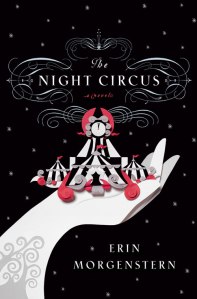
Synopsis: Le Cirque Des Revs is a traveling attraction open only at night. It arrives without warning. It leaves without notice. But within its black and white striped tents is a world that blends the boundaries between reality and imagination. And two young magicians—Celia and Marco—are bound to the circus as dueling competitors in a high-stakes game of which neither understands the rules or more importantly, the consequences.
Opinion:
Remember when you were a young kid and you read a book that transported you somewhere surreal, somewhere wonderful, somewhere magical? That’s how I felt when reading this book. Its pages hold ideas and settings that are more vivid and unique and fantastic than those of my own dreams. It made me long to visit Le Cirque Des Revs—or at least hope that someone adapts this dreamlike story into a film.
After a slow start (first 50 or so pages), this book picks up pace as you begin to see how the different characters are woven together with the night circus as the unifying thread. And by the time you’re grasping the overarching plot—two dueling magicians are fighting unknowingly in a competition to the death—it’s a full-blown magical, star-crossed love roller coaster ride.
I enjoyed the plot. I enjoyed the characters. I enjoyed the writing. But mostly, I enjoyed this book for its imaginative scenes within the circus walls: the ice garden, the merry-go-round, the cloud room, the grandfather clock. Morgenstern portrays magic and illusion in such a unique, intimate way that you can’t help but believe it must be real.
Overall: 4 out of 5
Who Should Read This Book: Adults who love logic-defying, limitless, magical stories. Those who are looking for a 19th Century romance novel that reads like a fantasy-mystery-thriller. Anyone who wants to be transported to a literary world of creative brilliance that’s so beautiful, you’ll want to savor every last word.




 writeamuck